


Introduction
Philae Temple is one of the principal archaeological sites of Aswan city Egypt, with monuments that stand today on Agilkia Island. The complex is centered on the sanctuary of Isis and contains structures dating mainly to the Ptolemaic period, alongside later Roman additions. The Temple of Isis was begun by Ptolemy II Philadelphus, who ruled from 285 to 246 BC.
The location visitors see today is not the temples' original setting. The monuments once occupied Philae Island but were moved to nearby Agilkia as part of the international campaign to protect Nubian heritage affected by the construction of the Aswan High Dam. The site now forms part of the UNESCO World Heritage property Nubian Monuments from Abu Simbel to Philae, inscribed in 1979.
Understanding that combination of ancient religion, Ptolemaic and Roman architecture, and modern conservation gives the complex much of its significance. A visit is also closely connected with the Nile: Agilkia Island is reached by boat, making the approach part of the site's present-day geography.
Table of content:
What Does Philae Temple History Tell Us?
The earliest surviving monument at the complex is the Kiosk of Nectanebo I, who ruled from 380 to 362 BC. Much of what survives, however, belongs to the Ptolemaic era, when the sanctuary of Isis developed into the major religious complex represented on Agilkia today.
A central chapter in Philae Temple history began under Ptolemy II Philadelphus. He started the prominent temple dedicated to Isis, mother of Horus, and later rulers continued to develop the sanctuary. The site's architecture consequently records more than one reign rather than representing a monument completed under a single king.
Philae remained an important center of the cult of Isis well beyond the Ptolemaic period. Roman emperors also left their mark on the complex, and UNESCO describes Philae as the great Ptolemaic sanctuary of Isis, where rulers through the Roman period added their names and monuments.
The sanctuary remained active unusually late in Egyptian history. Egypt's Ministry of Tourism and Antiquities records that the Temple of Isis continued functioning until the reign of Byzantine Emperor Justinian I, from AD 527 to 565. The site was subsequently used for Christian worship, and parts of the ancient complex were converted into a church.
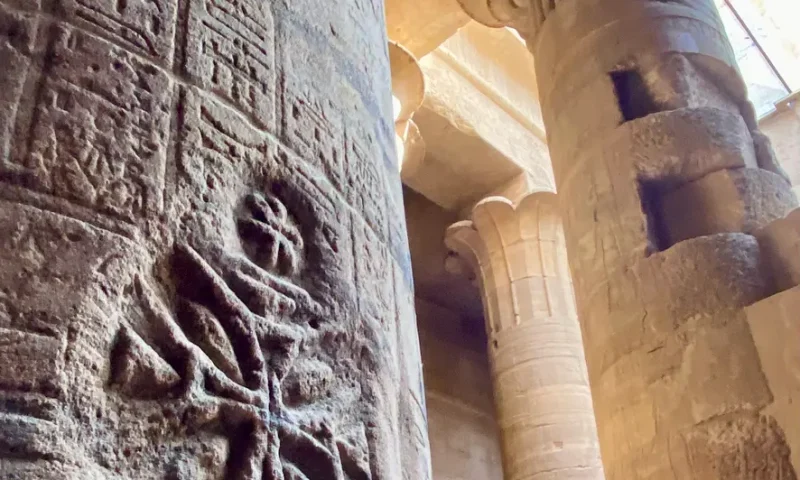
Philae also preserves a particularly important marker in the history of Egyptian writing. In AD 394, a priest of Isis named Esmet-Akhom carved the last known dated hieroglyphic inscription at the temple.
What Can You See at Philae Temple?
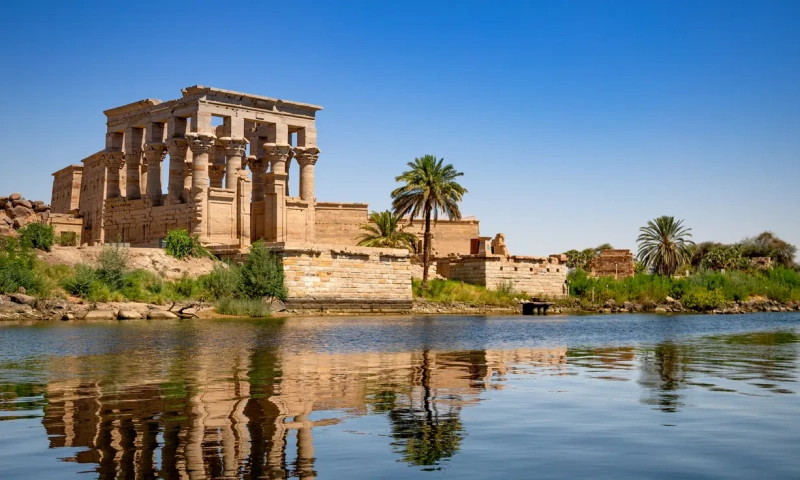
Although the Temple of Isis dominates the complex, Philae Temple should be understood as a collection of monuments rather than one isolated building. Structures associated with different rulers and periods stand across Agilkia Island, allowing visitors to trace changes in architecture and religious practice.
The Temple of Isis
The Temple of Isis forms the heart of Philae. Most of the building was constructed and decorated during the third and second centuries BC under the Ptolemies, and its spaces were devoted to the cult of Isis and traditions surrounding her divine family.
One significant feature is the mammisi, or birth house. A scene there depicts Isis nursing her son Horus among the marshes, connecting the temple's decoration with the divine birth traditions celebrated at the sanctuary.
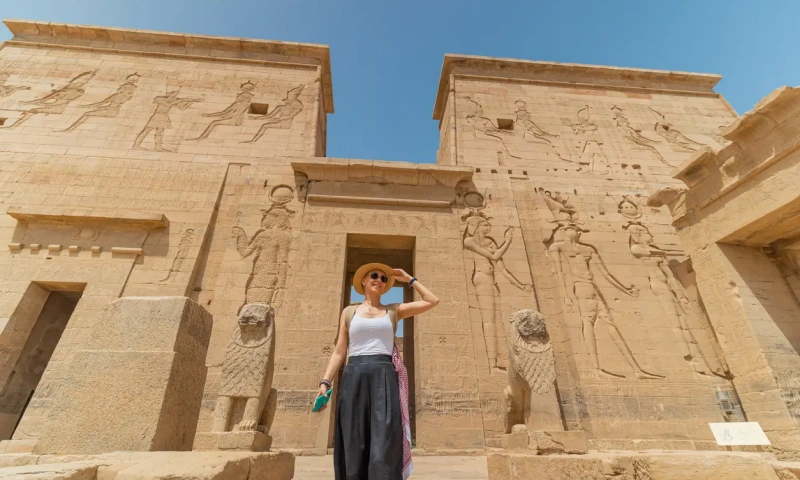
Moving through the complex reveals how pylons, courts, columned spaces and smaller chambers formed part of a functioning sanctuary. Reliefs across the temple preserve images of rulers interacting with deities, making the walls an important record of both religious practice and royal representation.
The Kiosk of Trajan
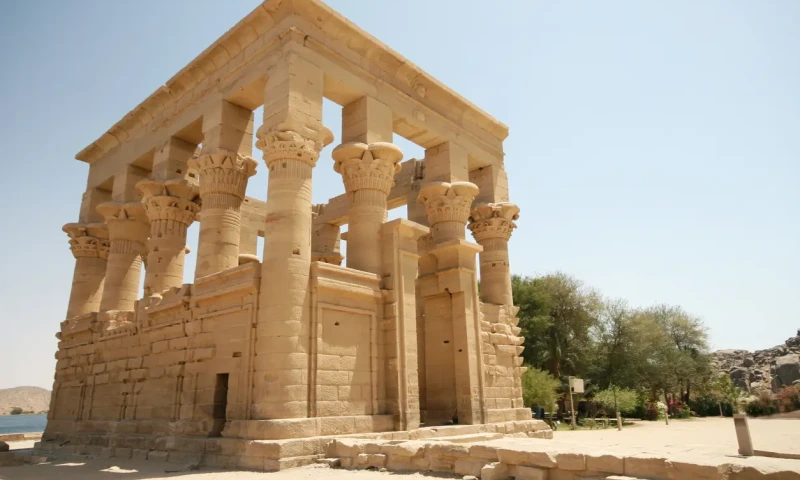
The Kiosk of Trajan is among Philae's most recognizable Roman-period structures. Associated with Emperor Trajan, who ruled from AD 98 to 117, it is formed by an orderly arrangement of columns, although its roof no longer survives.
Reliefs show Trajan making offerings to Isis, Osiris and Horus. The scenes demonstrate the continuation of traditional Egyptian religious imagery under Roman rule and help place Philae's later monuments within the sanctuary's much longer history.
The Temple of Hathor and Other Monuments
A smaller temple dedicated to Hathor was constructed under Ptolemy VI Philometor and later Emperor Augustus. Like other buildings at Philae, it reflects the continued development of the island across the Ptolemaic and Roman periods.
Other surviving monuments include the Kiosk of Nectanebo I, the Gate of Hadrian and structures dedicated to Imhotep and Augustus. Seen together, these buildings explain why the archaeological site is better approached as a temple complex built over generations rather than a single sanctuary from one moment in Egyptian history.
Why Was Philae Temple Moved to Agilkia Island?
The relocation is one of the defining episodes in modern Philae Temple history. Construction of the Aswan High Dam threatened archaeological sites across Nubia, leading Egypt and Sudan to request international assistance from UNESCO in 1959. UNESCO launched the International Campaign to Save the Monuments of Nubia in 1960.
Philae already experienced periodic submersion before the international rescue project. As changes to the Nile placed the monuments at greater risk, relocating the complex became the chosen solution. UNESCO records show that Agilkia Island was prepared for the monuments and reconstruction of the Philae structures began there in 1977.
The monuments were dismantled, transferred and reconstructed on higher ground. UNESCO states that the Philae monuments were transported to Agilkia between 1972 and 1979, making them the last major monuments relocated during the wider Nubian campaign.
That international effort went far beyond Philae. Twenty-two monuments and architectural complexes were saved during the campaign, including Abu Simbel and several other Nubian sites. The project's influence also contributed to the development of international approaches to heritage protection and preceded the adoption of the World Heritage Convention in 1972.
Today, Philae on Agilkia Island is one of ten component parts of the UNESCO property Nubian Monuments from Abu Simbel to Philae. The designation connects it with archaeological sites stretching through the Aswan region and southern Nubia.
How Should You Plan a Visit to Philae Temple?
Reaching Philae Temple involves a boat journey to Agilkia Island, south of Aswan. This makes the site straightforward to combine with other places around Aswan while still requiring visitors to account for the transfer by water when organizing their day.
Once on the island, allow enough time to look beyond the principal Temple of Isis. The Kiosk of Trajan, Temple of Hathor, Gate of Hadrian and other smaller monuments help explain how the sanctuary developed across different periods.
Travelers interested in southern Egypt can place Philae within a wider itinerary using an Aswan travel guide, particularly when combining the temple with Elephantine Island and other archaeological sites in the region. A visit also pairs naturally with an Abu Simbel temples guide, as both sites belong to the UNESCO-listed Nubian Monuments property.
Those traveling through Upper Egypt can connect Aswan with Luxor by comparing Nile cruise routes. This places Philae within a broader sequence of temples and archaeological sites along the Nile rather than treating it as an isolated excursion.
Visitor arrangements can change, so check current information from Egypt's Ministry of Tourism and Antiquities before traveling rather than relying on older schedules or ticket details.
FAQs
Where is Philae Temple?
Philae Temple is located on Agilkia Island south of Aswan and is reached by boat. The monuments were transferred there from their original location on Philae Island during the UNESCO campaign to protect Nubian heritage.
Who was the Temple of Philae dedicated to?
The principal sanctuary was dedicated to Isis, one of the major goddesses of ancient Egyptian religion. Ptolemy II Philadelphus began the prominent Temple of Isis, while later Ptolemaic and Roman rulers contributed to the wider complex.
What are the most important Philae Temple history facts?
Important Philae Temple history includes its development as a major sanctuary of Isis, its continuation into the Roman and Byzantine periods, and the AD 394 inscription representing the last known dated hieroglyphic text. The monuments were later relocated to Agilkia Island as part of UNESCO's Nubian safeguarding campaign.
Why was Philae Temple relocated?
The monuments were threatened by changing water levels connected with dam construction and the wider transformation of the Nile around Aswan. UNESCO's international campaign helped dismantle and reconstruct the Philae complex on the higher ground of Agilkia Island.
Is Philae a UNESCO World Heritage Site?
Yes. Philae on Agilkia Island forms part of the Nubian Monuments from Abu Simbel to Philae, which UNESCO inscribed on the World Heritage List in 1979. The serial property includes ten component parts across the Aswan region.
