

Introduction
Luxor Temple stands on the East Bank of the Nile in modern Luxor, within the remains of ancient Thebes. Known to the ancient Egyptians as Ipet-resyt, or the "Southern Sanctuary," the temple developed over centuries rather than under a single ruler. Its surviving architecture records the work of pharaohs including Hatshepsut, Amenhotep III, Tutankhamun, Horemheb and Ramesses II, followed by changes during the Roman period.
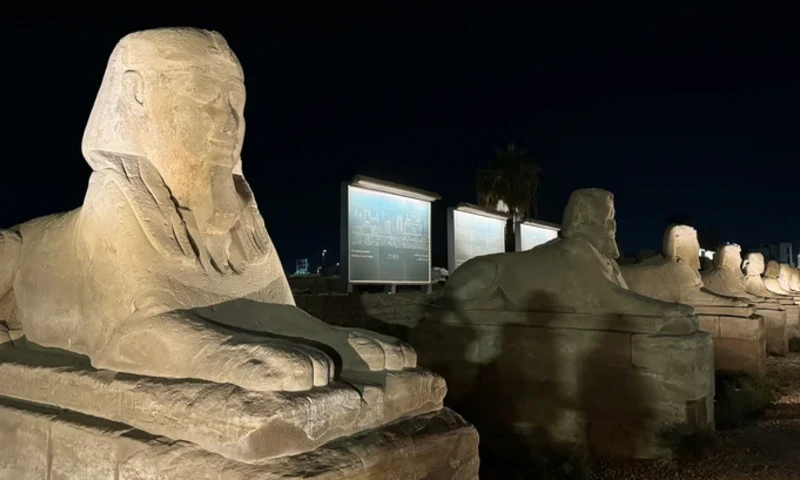
Unlike many Egyptian temples, its orientation is closely connected with Karnak, about three kilometers to the north. The two sanctuaries were linked by a ceremonial processional route lined with sphinxes and played central roles in the Opet Festival, one of the major religious celebrations of ancient Thebes.
Today, the temple forms part of the UNESCO World Heritage property of Ancient Thebes with its Necropolis, alongside Karnak and the archaeological landscape of Luxor's West Bank.
To combine Luxor Temple with other ancient sites along the Nile, explore our Nile River cruises and compare itineraries between Luxor and Aswan.
Table of content:
What Are the Most Important Facts About Luxor Temple?
Among the most useful facts about Luxor Temple is that the complex was not designed as a conventional funerary temple. Its religious significance was closely connected with Amun and the Opet Festival, during which the cult images of Amun, Mut and Khonsu traveled from their temples at Karnak to Luxor. The procession linked the two major sanctuaries and reinforced the temple's relationship with the religious life of Thebes.
The earliest surviving structure at the site is a shrine dating to the reign of Hatshepsut in the Eighteenth Dynasty. Much of the temple's core took shape under Amenhotep III, who ruled during the fourteenth century BC and was responsible for major construction projects across Egypt and Nubia. His work here included a courtyard, columned spaces and the Great Colonnade.
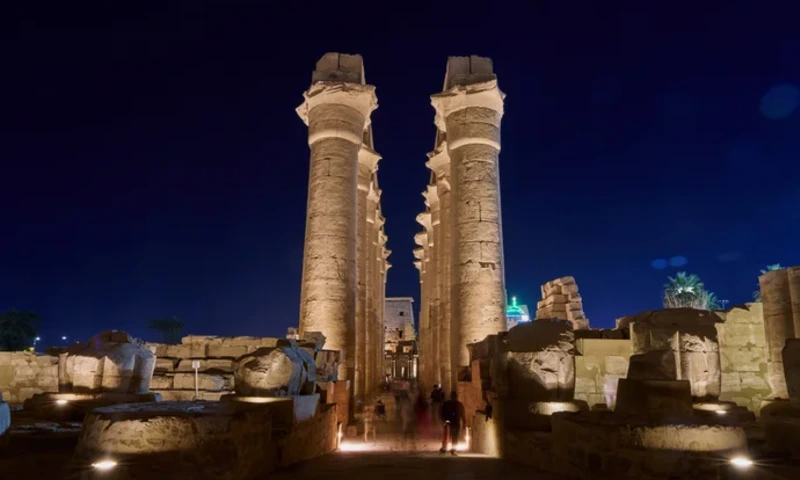
Amenhotep III's Great Colonnade consists of two rows of seven monumental columns. Scenes depicting the Opet Festival were later completed under Tutankhamun and Horemheb, giving the structure a direct visual connection with the ceremonies for which the temple was used.
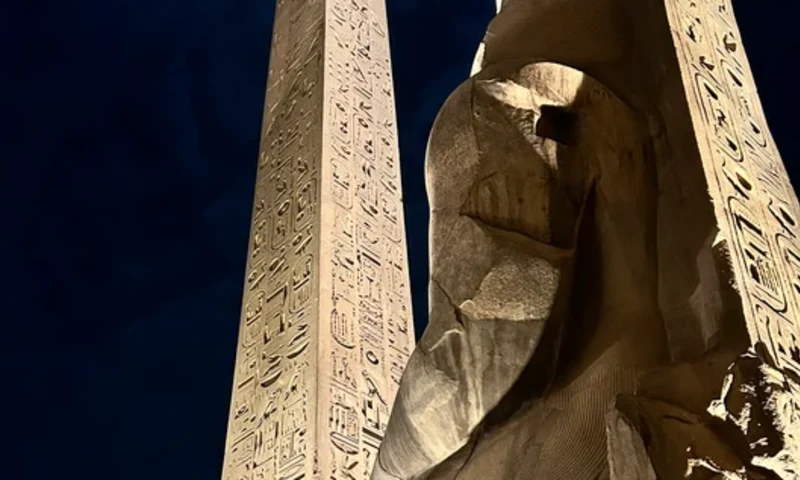
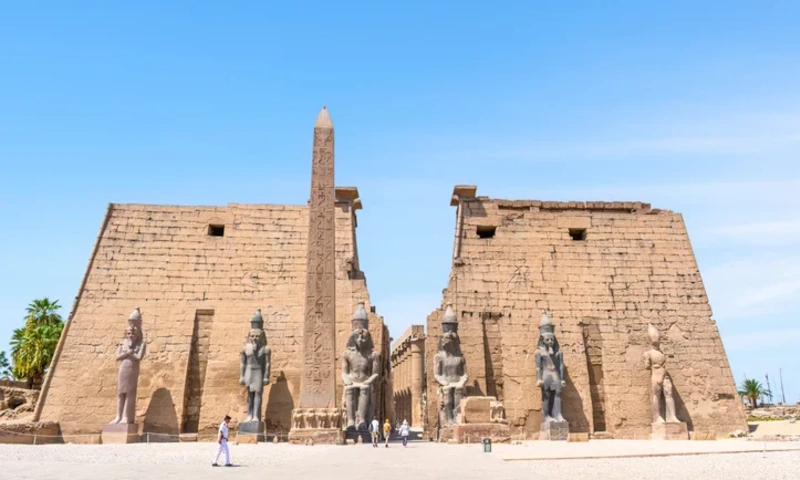
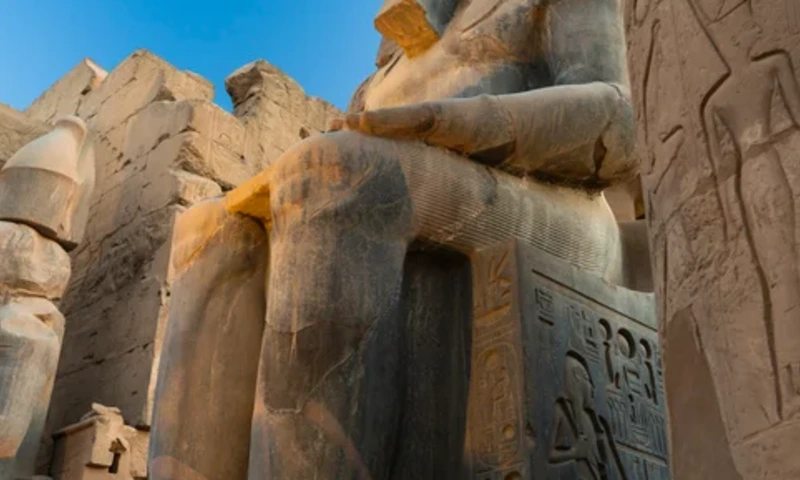
Ramesses II transformed the northern approach with another courtyard and a monumental pylon. In front of this entrance stood colossal royal statues and a pair of obelisks, each about 25 meters high. One remains at the temple; its partner has stood in the Place de la Concorde in Paris since 1836.
What Should You See Inside Luxor Temple?
Walking through Luxor Temple reveals how different rulers added to an existing sacred space rather than replacing what came before. The sequence of pylons, statues, courts, columns and inner rooms makes these successive building phases relatively easy to follow.
Ramesses II's Pylon and Courtyard
The monumental entrance created by Ramesses II forms one of the temple's most recognizable sections. The pylon consists of two large towers marking the entrance, accompanied by royal statues and the surviving obelisk.
Beyond it lies the courtyard added by Ramesses II. This section represents a later expansion of a temple whose central structures had already been established under Amenhotep III. The shift from the Ramesside entrance toward the earlier colonnade allows visitors to see how the complex grew across different reigns.
The Great Colonnade of Amenhotep III
Amenhotep III's Great Colonnade is formed by fourteen colossal columns arranged in two rows. Their scale creates a ceremonial passage between the Ramesside additions and the older parts of the sanctuary.
The reliefs here are particularly valuable for understanding the Opet Festival. Their decoration was completed during the reigns of Tutankhamun and Horemheb, preserving scenes connected with the movement of the divine procession between Karnak and Luxor.
Amenhotep III's Court and Inner Temple
Deeper inside are the structures associated with Amenhotep III, including a courtyard surrounded by columns and rooms belonging to the temple's core. One of the inner chambers preserves the Divine Birth scenes, which connect the king's divine legitimacy with Amun-Ra.
These spaces help explain why the temple is more than a collection of monumental architecture. Its reliefs and layout also record ideas about kingship, divine authority and ritual that shaped New Kingdom Thebes.
The Roman Sanctuary
The site's history continued long after the New Kingdom. In the late third century AD, Roman forces established a fort around the temple, and a room beyond Amenhotep III's hypostyle hall was adapted as a sanctuary.
Ancient Egyptian wall reliefs in this area were covered with plaster and painted with Graeco-Roman-style scenes depicting Emperor Diocletian and his three coregents. The surviving traces provide evidence of how the complex acquired new functions during the Roman period.
To place Luxor Temple within a wider journey through Egypt’s ancient sites, explore our Egypt travel package and see how Luxor can fit into a broader itinerary.
Why Was Luxor Temple Important to Ancient Thebes?
The temple cannot be fully understood in isolation from Karnak. Its unusual orientation points toward the larger sanctuary to the north, reflecting the ceremonial connection between the two complexes.
During the Opet Festival, images of Amun, Mut and Khonsu were carried from Karnak in procession to the southern sanctuary. This relationship explains both the orientation of Luxor Temple and the importance of the sphinx-lined processional route linking the two sites.
The wider setting matters as well. Ancient Thebes served as Egypt's capital during periods of the Middle and New Kingdoms and remained one of the country's major religious centers. UNESCO's Ancient Thebes with its Necropolis property includes the temples of Karnak and Luxor on the East Bank together with the extensive archaeological landscape on the West Bank, including the Valley of the Kings and Valley of the Queens. The property entered the World Heritage List in 1979.
This broader context places the temple within a landscape of royal, religious and funerary monuments rather than treating it as an isolated attraction.
How Should You Plan a Visit to Luxor Temple?
The temple stands on Luxor's East Bank, making it practical to combine with other archaeological sites in the city. Karnak lies roughly three kilometers to the north, while the West Bank contains the royal tombs, memorial temples and other remains of the Theban necropolis.
Allow enough time to look beyond the largest structures. The pylon and statues immediately draw attention, but the Great Colonnade, Opet reliefs, Amenhotep III's architectural work and later Roman alterations are essential for understanding how the site changed over time.
Current access conditions and opening arrangements can change, so check the official Egyptian Ministry of Tourism and Antiquities information before visiting. Pairing the temple with Karnak also gives clearer context to the ancient processional route and the religious relationship between the two sanctuaries.
To include Luxor’s East and West Bank sites within a broader itinerary, explore our Best Egypt Tour and see how the city’s temples and royal sites fit into a wider journey through Egypt.
FAQs
Where is Luxor Temple?
Luxor Temple is on the East Bank of the Nile in modern Luxor, within the ancient city of Thebes. Karnak Temple lies approximately three kilometers to the north, and the two sanctuaries were historically connected by a sphinx-lined processional route.
Who built Luxor Temple?
No single pharaoh built the entire complex. The oldest surviving shrine dates to Hatshepsut, the core was largely built by Amenhotep III, and later rulers including Tutankhamun, Horemheb and Ramesses II contributed decoration or major additions.
What are some important facts about Luxor Temple?
Key facts about Luxor Temple include its ancient name, Ipet-resyt, its ceremonial connection with Karnak and its role in the Opet Festival. It also preserves architecture from several periods, including major New Kingdom construction and later Roman alterations.
What was the Opet Festival?
The Opet Festival was an important religious celebration in ancient Thebes. Cult images of Amun, Mut and Khonsu traveled from Karnak to the southern sanctuary, linking the two temple complexes through a ceremonial procession.
Is Luxor Temple part of a UNESCO World Heritage Site?
Yes. The temple forms part of Ancient Thebes with its Necropolis, which also includes Karnak and major archaeological areas on Luxor's West Bank. The property was inscribed on the UNESCO World Heritage List in 1979.