


Introduction
Karnak Temple stands on the east bank of the Nile at Luxor, within the ancient city of Thebes. Rather than a single temple built by one ruler, Karnak developed over centuries as successive kings added temples, pylons, courts, obelisks and other structures. Its oldest evidence as the principal place of worship of Amun dates to the Middle Kingdom, while major building activity continued through later periods.
At the heart of the complex lies the Precinct of Amun-Re, where the scale of ancient Egyptian religious architecture becomes particularly clear. The Great Hypostyle Hall, monumental obelisks, temples and Sacred Lake all formed part of a religious center closely tied to the importance of Thebes and the cult of Amun. Karnak and Luxor Temple are now part of the UNESCO World Heritage property Ancient Thebes with its Necropolis.
Table of content:
What Are the Most Important Facts About Karnak Temple?
Among the most useful facts about Karnak Temple is that its history cannot be assigned to a single reign. The earliest evidence for Amun’s main sanctuary here dates to the Middle Kingdom, when Thebes was becoming increasingly important. By the end of the New Kingdom, Karnak had developed into the largest and wealthiest ancient Egyptian religious establishment.
Its growth closely followed the rise of Amun and the political importance of Thebes. During the New Kingdom, rulers directed substantial resources toward construction at the complex, leaving architecture and inscriptions associated with different generations of Egyptian kings.
Karnak also belongs to a much broader archaeological landscape. UNESCO’s Ancient Thebes property includes Karnak and Luxor temples on the east bank of the Nile as well as a large archaeological area on the west bank containing temples and royal necropolises, including the Valley of the Kings and Valley of the Queens.
What Should You See Inside Karnak Temple?
Walking through Karnak Temple means moving through architecture created and altered across different periods rather than following the plan of a monument completed at one moment. Courts open into columned halls, pylons divide major spaces, and individual temples and chapels reflect the complex religious history of ancient Thebes.
Several features deserve particular attention because they help explain both Karnak’s scale and its role as a major center of worship.
The Great Hypostyle Hall
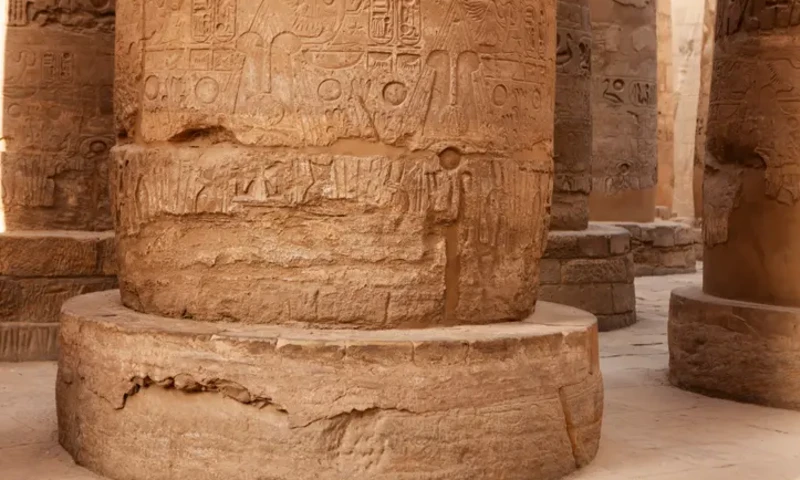
The Great Hypostyle Hall is one of Karnak’s defining architectural spaces. Its roof was supported by 134 massive columns arranged across an area of about 5,000 square metres. Twelve taller columns formed the central nave, rising to roughly 20–21 metres.
The hall may have been initiated earlier, but the main construction and decoration belong to the 19th-Dynasty kings Seti I and his son Ramesses II. Walking between the columns gives a direct sense of how Egyptian builders used height, repetition and carved surfaces to shape a ceremonial interior on an enormous scale.
Look beyond the dimensions and the hall becomes a record of royal patronage. Reliefs and inscriptions across its columns and walls connect the architecture with the rulers responsible for developing and decorating this part of the sanctuary.
Hatshepsut's Obelisk
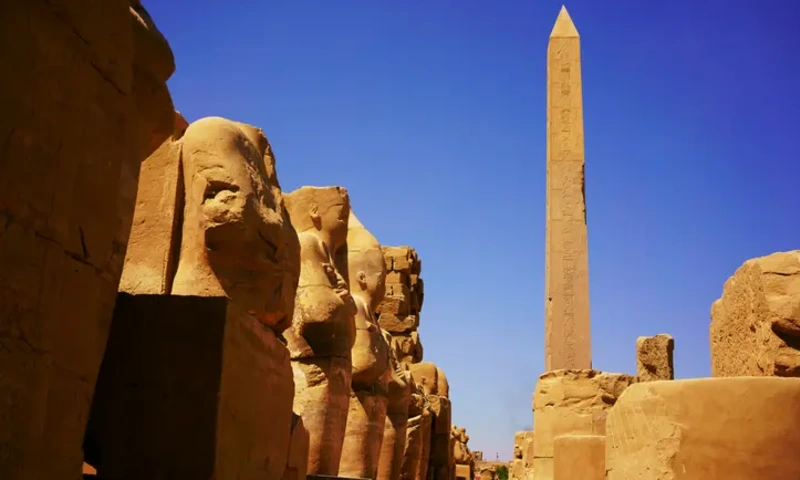
Obelisks were important elements within Karnak’s monumental landscape. One of the most prominent surviving examples was erected by Hatshepsut, the 18th-Dynasty ruler whose reign saw extensive building activity in Thebes.
Her standing obelisk reaches almost 30 metres and weighs more than 300 tons. Its presence among the pylons, courts and columns illustrates the technical ambition behind royal construction at Karnak while also showing how individual rulers inserted their monuments into an already developing sacred complex.
The Sacred Lake
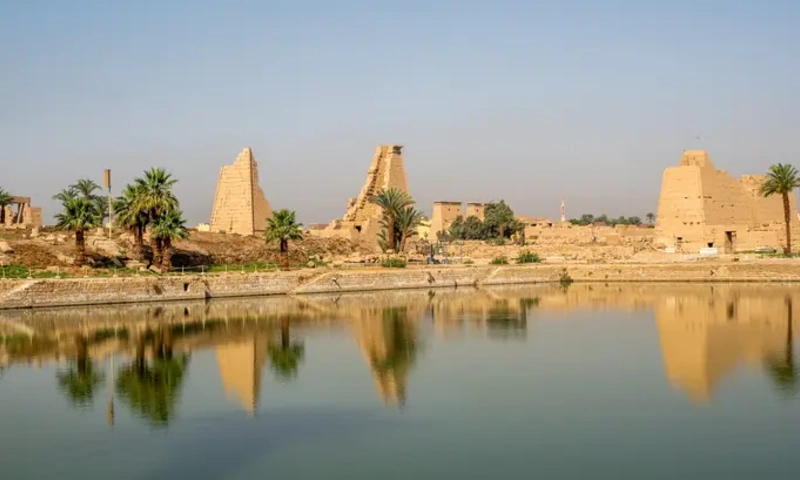
The Sacred Lake introduces a different aspect of temple life. According to Egypt’s Ministry of Tourism and Antiquities, priests used the lake for purification before performing temple rituals.
Its function is a useful reminder that Karnak was an active religious institution rather than simply a collection of monumental buildings. Ritual practices, priesthoods and temple ceremonies were central to the complex throughout its long history.
The Temple of Khonsu and Akh-menu
The southwestern corner of the Amun precinct contains the Temple of Khonsu, dedicated to the moon god Khonsu. Construction began under Ramesses III on the remains of an earlier 18th-Dynasty temple, with later additions made during subsequent periods.
At Karnak’s eastern end stands the Akh-menu, built by Thutmose III. The structure was associated with the cults of several deities, earlier kings and the ruler himself. Smaller temples and chapels elsewhere across the complex further demonstrate how Karnak expanded through repeated phases of royal and religious building.
Why Was Karnak Important to Ancient Thebes?
The importance of Karnak Temple is closely connected to Amun, one of the principal gods of Thebes. Amun rose in prominence alongside the city, and his sanctuary at Karnak became increasingly significant as Thebes developed into one of ancient Egypt’s major political and religious centers.
Thebes served as Egypt’s capital during periods of the Middle and New Kingdoms and functioned as the country’s religious capital through much of ancient Egyptian history. Karnak’s repeated expansion reflects that status: rulers could associate themselves with Amun while leaving architectural and textual records of their reigns within the sanctuary.
The relationship between Karnak and the surrounding city is equally important. Luxor Temple stands farther south on the east bank, while the west bank contains royal tombs and temples associated with the Theban necropolis. Seen together, these sites explain why UNESCO treats Ancient Thebes as an interconnected cultural landscape rather than a collection of unrelated monuments.
Travelers planning more time in Upper Egypt can place the temple in context by pairing it with a Luxor city guide and comparing Nile cruise itineraries that connect Luxor with Aswan.
How Can You Plan Your Karnak Temple Visit?
The size and architectural complexity of Karnak Temple reward a visit approached at a comfortable pace. The Great Hypostyle Hall may draw immediate attention, but focusing only on its columns means missing obelisks, smaller temples, chapels and ritual spaces that explain how the complex developed.
A logical route through the major architectural areas can make the site easier to understand. Notice how pylons divide different sections, how the scale changes between open courts and columned spaces, and how inscriptions and royal monuments belong to different periods rather than assuming everything was constructed together.
Visitor arrangements can change, so check current information from Egypt’s Ministry of Tourism and Antiquities before traveling rather than relying on older opening or ticket details. Comfortable footwear is useful for exploring an extensive archaeological site, along with suitable sun protection and water for time spent outdoors.
Karnak also makes more sense when viewed as part of Luxor rather than in isolation. Luxor Temple, the Valley of the Kings, funerary temples and other remains across ancient Thebes provide the wider historical setting for understanding why this stretch of the Nile became so important.
FAQs
Where is Karnak Temple?
Karnak Temple is in Luxor on the east bank of the Nile, within the area of ancient Thebes. Together with Luxor Temple and the Theban necropolis, it forms part of the UNESCO World Heritage property Ancient Thebes with its Necropolis.
Who built Karnak Temple?
Karnak was not built by one pharaoh. Evidence for Amun’s principal sanctuary dates to the Middle Kingdom, while numerous rulers expanded and altered the complex over later centuries, particularly during the New Kingdom.
What are some important facts about Karnak Temple?
Useful facts about Karnak Temple include that the Great Hypostyle Hall contains 134 columns, Hatshepsut’s surviving obelisk rises almost 30 metres, and the complex contains a Sacred Lake used for priestly purification. It also includes numerous temples and chapels created during different periods.
What is the Great Hypostyle Hall at Karnak?
The Great Hypostyle Hall is a vast columned space within the Amun precinct. Its 134 columns include 12 taller central columns, and the main construction and decoration are associated with Seti I and Ramesses II.
Is Karnak part of a UNESCO World Heritage Site?
Yes. Karnak forms part of Ancient Thebes with its Necropolis, which UNESCO inscribed on the World Heritage List in 1979. The property also includes Luxor Temple and major archaeological areas on the west bank of the Nile.
