


Introduction
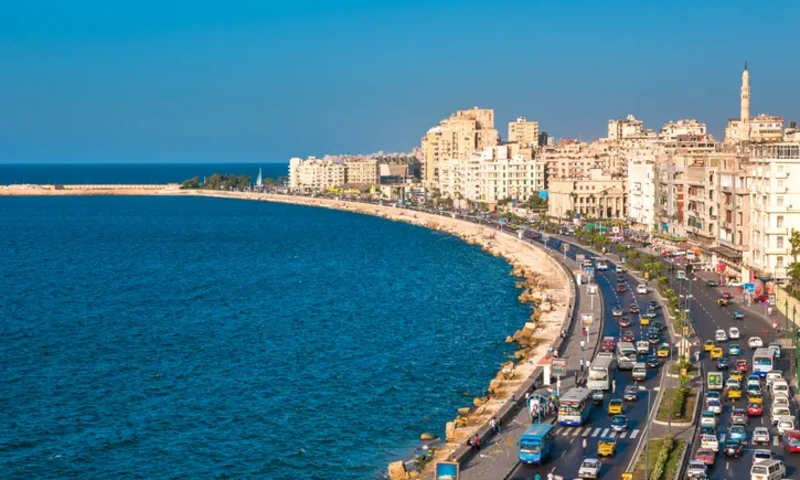
Alexandria city stretches along Egypt's Mediterranean coast, bringing together more than two millennia of history with a modern seafront city. Alexander the Great founded Alexandria in 331 BC near an earlier Egyptian settlement known as Rhakotis, and the city later became the capital of Ptolemaic Egypt and one of the ancient Mediterranean's major centers of scholarship, politics, and trade.
Today, travelers encounter that past in layers rather than within a single archaeological zone. Roman remains survive at Kom el-Dikka and Kom el-Shoqafa, Qaitbay Citadel occupies the end of the former Pharos peninsula, and underwater archaeology continues to document structures and monumental remains beneath the Eastern Harbour. The modern Bibliotheca Alexandrina adds a contemporary cultural institution to a city still closely associated with learning.
For travelers looking for reliable facts about Alexandria, it helps to understand the city's geography. Many of its best-known places are spread along or close to the Mediterranean waterfront, while archaeological sites and museums lie farther inland. Planning by area can make a visit much easier to organize.
Table of content:
Highlights of Alexandria City
-
Walk along Alexandria's Mediterranean waterfront and Corniche.
-
Visit Qaitbay Citadel on the former Pharos peninsula.
-
Explore the Roman-era Catacombs of Kom el-Shoqafa.
-
See Diocletian's Column, widely known as Pompey's Pillar, beside the remains of the Serapeum.
-
Walk through the Roman and Byzantine remains of Kom el-Dikka.
-
Visit the Bibliotheca Alexandrina and its cultural spaces.
-
Explore the Alexandria National Museum for a broader view of the city's history.
-
Spend time in the royal gardens of Montazah.
-
Learn how underwater archaeology is revealing parts of ancient Alexandria beneath the Mediterranean.
Facts About Alexandria and Its Ancient Past
Among the most important facts about Alexandria is its role as the capital of Egypt under the Ptolemies. After Alexander's death, Ptolemy I took control of Egypt, and Alexandria became the seat of a dynasty that continued until the reign of Cleopatra VII. The city remained one of the eastern Mediterranean's leading urban centers into the Roman and Byzantine periods.
Ancient Alexandria was associated with two structures whose reputations extended far beyond Egypt: the Great Library and the Lighthouse of Pharos. Neither survives in its original form, but both remain central to the city's identity. The ancient lighthouse stood on Pharos Island, while the city itself was linked to the island by the Heptastadion causeway, helping create Alexandria's eastern and western harbors.
Much of what survives above ground comes from later periods. Other evidence lies beneath the water. Archaeological work around the Eastern Harbour and Qaitbay area has identified architectural elements, statues, and remains linked with the ancient royal and maritime quarters.
Catacombs of Kom el-Shoqafa
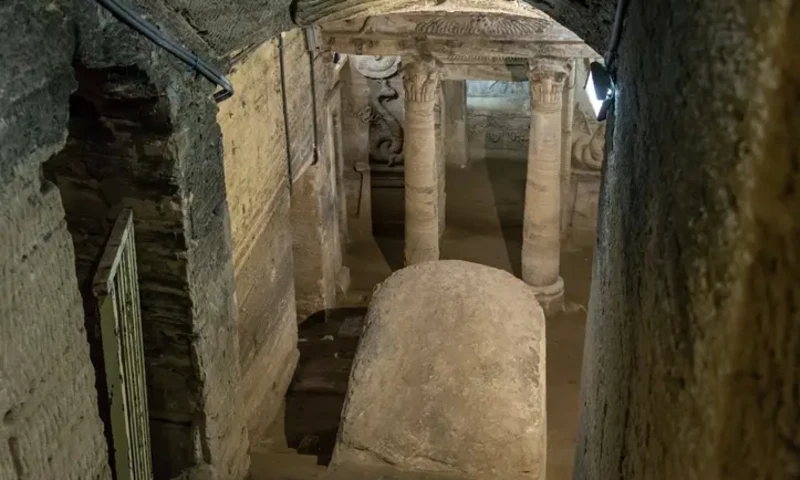
The Catacombs of Kom el-Shoqafa belong to the Roman period and are among Alexandria's best-known surviving burial sites. Their chambers combine Egyptian and Greek artistic and religious traditions, reflecting the mixed cultural world that developed in Alexandria under Greek and Roman rule.
Visitors move through an underground funerary complex that includes burial spaces, a chapel, and an area associated with funeral banquets. Rather than presenting a purely Egyptian or classical style, the decoration shows how traditions overlapped within Roman Alexandria.
Pompey's Pillar and the Serapeum
The monument commonly called Pompey's Pillar is actually a column erected in honor of the Roman emperor Diocletian in the late third century AD. It stands beside the remains of the Serapeum, once Alexandria's principal temple dedicated to Serapis.
The site is useful for understanding how Alexandria changed after the Ptolemaic period. Roman imperial monuments stood alongside religious institutions that combined Egyptian and Greek elements, creating a city whose identity was shaped by several cultures.
Kom el-Dikka
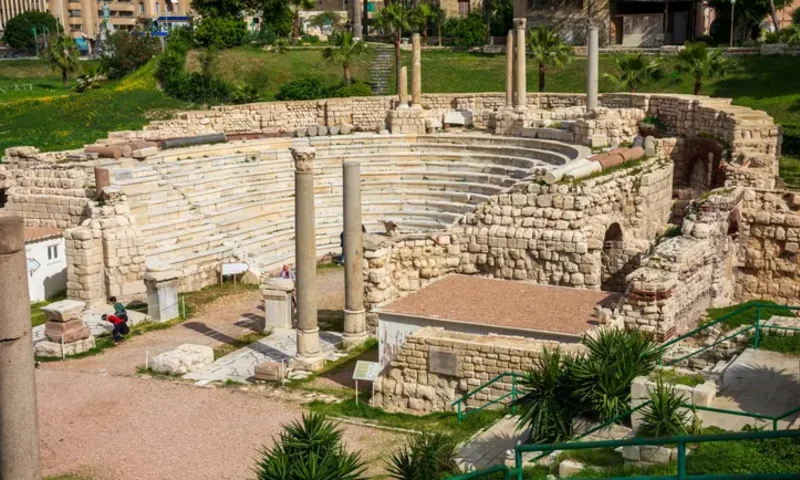
Kom el-Dikka occupies part of central modern Alexandria and preserves a Roman and Byzantine civic and residential quarter dating from roughly the second to sixth centuries AD. Archaeologists have identified an odeon often referred to as the Roman Theater, bath complexes, lecture halls, workshops, and houses with mosaic floors.
The site gives a particularly clear sense of urban life. Instead of focusing on one temple or tomb, visitors see spaces connected with education, bathing, housing, craftsmanship, and public gatherings.
Alexandria City Along the Mediterranean
The relationship between Alexandria city and the Mediterranean is visible throughout the visit. The Corniche follows the coast for much of the city, while the Eastern Harbour occupies an area that once formed part of ancient Alexandria's royal and maritime center. Archaeological remains beneath these waters trace a coastline very different from the one seen today.
Qaitbay Citadel
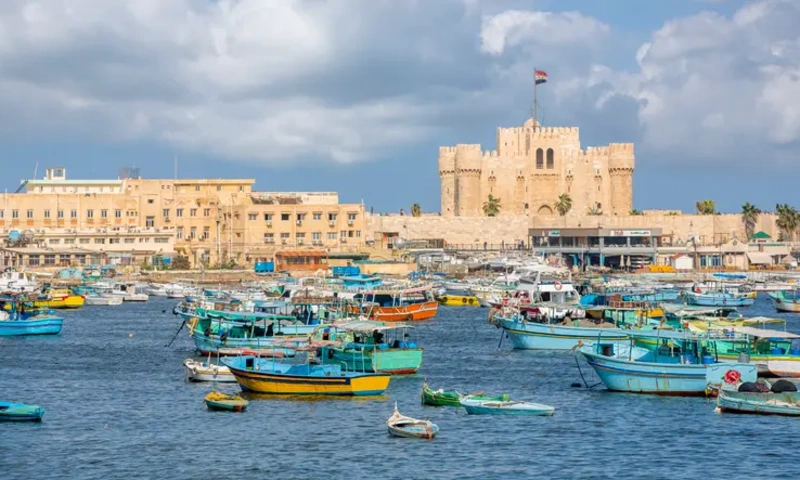
Qaitbay Citadel stands at the eastern end of the Pharos peninsula. Sultan al-Ashraf Qaitbay built the fortress between 1477 and 1479 over the ruins of Alexandria's ancient lighthouse, using the strategic location to strengthen the city's defenses against attacks from the sea.
Its limestone walls, defensive towers, inner courtyard, and central keep reflect its military purpose. The location also creates a direct physical connection between medieval Alexandria and the site associated with the Lighthouse of Pharos.
Archaeological investigations in the water beside the citadel have recorded thousands of architectural fragments and other objects, including material associated with the ancient lighthouse and the wider city.
Bibliotheca Alexandrina
The Bibliotheca Alexandrina stands on the waterfront in the Shatby district as a modern institution inspired by Alexandria's ancient reputation for scholarship. Its complex includes the main library, specialized libraries, museums, research centers, exhibitions, a planetarium, and spaces for conferences and cultural events.
A visit here works differently from Alexandria's archaeological sites. Instead of examining surviving ancient structures, travelers encounter a contemporary cultural center created around the city's long association with books, scholarship, science, and international exchange.
Montazah Gardens
At the eastern end of the city, Montazah provides a different side of Alexandria. The landscaped grounds once belonged to Egypt's royal family and include historical palace buildings, coastal areas, and extensive gardens.
Montazah can provide a quieter addition to an itinerary dominated by archaeological sites and museums. Its position farther east means it is usually easier to treat it as a separate part of the day's planning rather than combine it with every central attraction.
Museums and Cultural Life in Alexandria
The Alexandria National Museum is a useful place to place the city's different periods into context. Housed in a former Italianate palace, the museum presents material spanning from prehistory to the modern era and includes antiquities recovered from underwater excavations in Abu Qir Bay.
The museum's broad chronology helps explain why Alexandria cannot be understood only as a Greek or Roman city. Pharaonic, Graeco-Roman, Coptic, Islamic, and later Egyptian histories all form part of the wider story presented through its collections.
The city's cultural identity also reflects communities that lived here across different periods. Churches, mosques, and synagogues form part of Alexandria's architectural history, while modern museums and cultural institutions preserve connections with communities that once contributed to its cosmopolitan character.
Alexandria's modern life remains closely tied to the coast. Walking along the waterfront between sightseeing stops gives travelers a clearer sense of the city's scale than moving only between individual monuments.
Practical Information for Visiting Alexandria
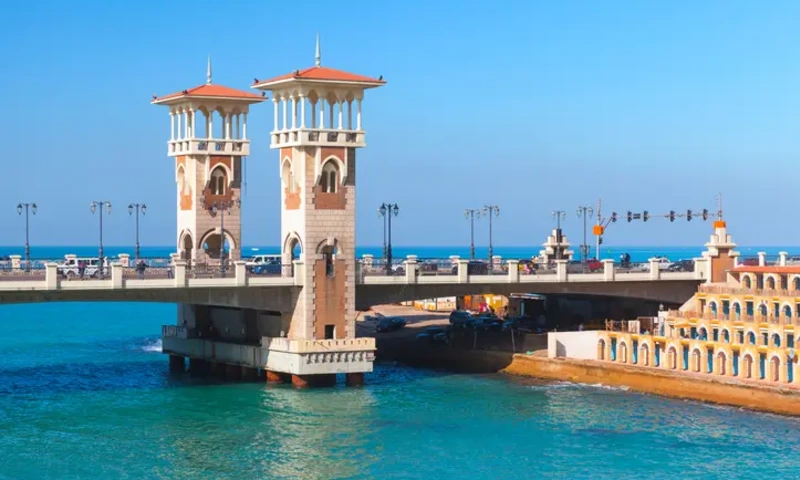
Because Alexandria city extends for a considerable distance along the Mediterranean, grouping attractions by location can save unnecessary travel. Qaitbay Citadel and the western side of the Eastern Harbour fit naturally together, while the Bibliotheca Alexandrina and Shatby occupy another section of the waterfront.
Kom el-Shoqafa, Pompey's Pillar, Kom el-Dikka, and the Alexandria National Museum lie away from the seafront or in different central districts. Building an itinerary around two or three nearby places at a time usually works better than moving repeatedly from one end of the city to the other.
Comfortable footwear is useful at archaeological sites where surfaces may include stone steps and uneven ground. Modest clothing is appropriate when entering religious buildings, while museums and archaeological attractions may maintain their own rules for photography, bags, and visitor access.
Opening arrangements can change, so check official information shortly before visiting rather than relying on older schedules. This is especially helpful for museums, archaeological sites, cultural institutions, and gardens.
Alexandria can also fit naturally into a wider Egypt itinerary. Travelers combining the Mediterranean coast with the capital can continue planning with a Cairo travel guide, while those traveling south can add Luxor and Aswan for a very different archaeological landscape.
FAQs
What is Alexandria city known for?
Alexandria city is known for its Mediterranean setting, Ptolemaic and Roman history, Qaitbay Citadel, Kom el-Shoqafa Catacombs, Kom el-Dikka, and the Bibliotheca Alexandrina. It was founded by Alexander the Great in 331 BC and later served as the capital of Ptolemaic Egypt.
What are the most important facts about Alexandria for travelers?
Useful facts about Alexandria include its long coastal layout and its combination of archaeological remains, medieval architecture, museums, and modern cultural institutions. Attractions are spread across several districts, so organizing sightseeing geographically can make a visit easier.
Was the ancient Lighthouse of Alexandria where Qaitbay Citadel stands today?
Qaitbay Citadel was built in the fifteenth century over the ruins of the ancient Lighthouse of Alexandria at the end of the Pharos peninsula. Archaeological work in the surrounding water has also identified material associated with the lighthouse and ancient waterfront.
Is the Bibliotheca Alexandrina the ancient Library of Alexandria?
No. The ancient Library of Alexandria has not survived. The Bibliotheca Alexandrina is a modern library and cultural complex inspired by Alexandria's historical role as a center of scholarship and learning.
What archaeological sites can you visit in Alexandria?
Major archaeological sites include Kom el-Shoqafa, the Serapeum area with the column known as Pompey's Pillar, and Kom el-Dikka. Each represents a different aspect of Alexandria's Graeco-Roman and later urban history.
